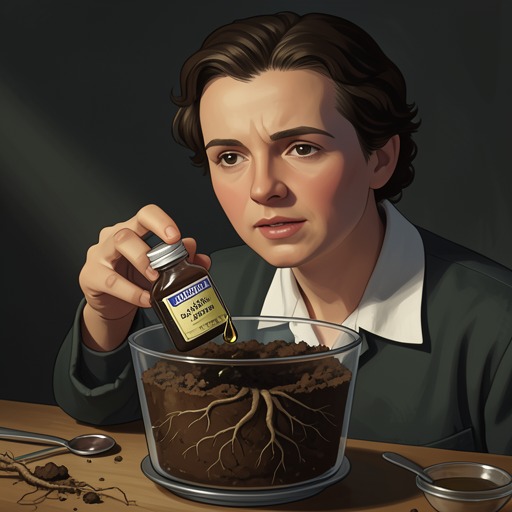
Environmental contamination by synthetic pesticides
Silent SpringEnvironmental contamination by synthetic pesticides is the spread of persistent poisons through air, soil, water, and living tissue, turning separate applications into a connected chain of exposure. In Silent Spring, Rachel Carson makes that contamination a defining environmental danger of the postwar age: chemicals used to control pests do not remain where they are applied, but travel through ecosystems, accumulate in bodies, and create consequences that may outlast the act of spraying itself.
A New Scale of Environmental Change
Carson frames chemical pollution as an assault whose power has grown not only in magnitude but in character. Dangerous substances contaminate air, earth, rivers, and sea; much of this pollution, she argues, cannot be recovered, and the chain of harm it initiates in both the life-supporting world and living tissues is largely irreversible. Chemicals thus become partners of radiation in changing the nature of the environment and of life within it.
The book makes the reach of this change concrete through two parallel routes. Strontium 90 released by nuclear explosions falls from the air, settles into soil, enters grass, corn, or wheat, and eventually lodges in human bones for the remainder of life. Synthetic pesticides follow a comparable passage: material sprayed on cropland, forest, or garden can persist in soil, enter organisms, and pass from one living thing to another in a chain of poisoning and death. Some chemicals also move through underground streams, emerging far from the site where they were first released.
Carson describes pesticide exposure as effectively universal. Within less than two decades of use, synthetic pesticides had been distributed so thoroughly through animate and inanimate environments that residues appeared virtually everywhere. They had been recovered from most major river systems and from groundwater streams flowing unseen below the surface. The contamination was not confined to a conspicuous spill or to the boundaries of a treated field; its defining feature was its dispersal through ordinary landscapes and their hidden connections.
Persistence, Movement, and Accumulation
The environmental danger depends on duration as much as on the immediate toxicity of a dose. Chemicals sprayed on land can remain in soil, while movement through water and living organisms carries them beyond the original application area. Each transfer links places and species that a pest-control operation might treat as separate. A field, a stream, an animal, and a human body become successive points in one exposure pathway.
Within the body, DDT illustrates how exposure can be retained and magnified. Because the chemical is fat-soluble, it is stored largely in organs rich in fatty substances, including the adrenals, testes, and thyroid; substantial amounts are also deposited in the liver, kidneys, and protective fat surrounding the intestines. Carson emphasizes that storage begins even with very small intake, including residues present on food, and can continue as the chemical is only slowly excreted.
The body’s fatty stores act as biological magnifiers. Carson gives the example that a dietary intake as low as one part per million can result in storage of roughly 10 to 15 parts per million. The significance is not merely that a chemical enters the body, but that repeated low-level exposure can accumulate internally, making the eventual burden different in scale from any single intake.
Delayed Effects and Mixed Exposures
Carson distinguishes the conspicuous danger of acute poisoning from the broader problem of chronic exposure. A sufficiently large single exposure can precipitate acute poisoning, and the sudden illness or death of farmers, spray workers, pilots, and others exposed to appreciable quantities is tragic. But she treats these visible episodes as only part of the risk. Smaller amounts can be stored cumulatively, excreted slowly, and associated with chronic poisoning and degenerative changes in the liver and other organs.
That concern is sharpened by the mismatch between small cause and consequential effect in biological systems. Carson notes that an amount of iodine as small as two ten-thousandths of a gram can mark the difference between health and disease. Against that background, the gradual retention of pesticide residues cannot be judged solely by whether any one dose produces an immediate symptom. The relevant exposure is cumulative, and its effects may emerge on a different timescale from the application that began it.
Exposure also rarely occurs to one chemical in isolation. A human being, unlike a laboratory animal maintained under rigidly controlled conditions, encounters multiple chemicals; insecticide groups and other substances may interact after release into soil or water or after entering the bloodstream. In one example, Food and Drug Administration scientists found that administering malathion simultaneously with certain other organic phosphates could produce poisoning up to fifty times as severe as would be predicted by adding their separate effects. Contamination therefore involves not only the persistence of individual substances but also the uncertain consequences of mixtures.
The Evidence in Living Landscapes
The book’s cases show how contamination becomes legible through effects in wildlife. At Clear Lake, California, a third campaign against the resilient gnat population in 1957 was followed by further grebe deaths. Examination found no evidence of infectious disease. Analysis of the birds’ fatty tissue instead revealed DDD at 1,600 parts per million, a striking contrast with the much lower concentration applied to the water. The episode gives bodily accumulation a visible ecological consequence: a chemical present in the environment was concentrated within birds that had died there.
The same argument extends beyond one lake. In the fall of 1959, about 27,000 acres in southeastern Michigan, including suburbs of Detroit, were dusted from the air with pellets of aldrin, one of the most dangerous chlorinated hydrocarbons. The scale and suburban reach of the program underscore how ordinary community and government actions could distribute potent chemicals across inhabited landscapes, rather than confining exposure to agricultural plots or remote wilderness.
Carson also places chemical control beside evidence that ecological restraints can develop without blanket poisoning. The Japanese beetle, after entering the United States, increased rapidly during its first dozen years, free from the checks that held it in its native land. By 1945 it had become a pest of only minor importance across much of the territory it had invaded. Its decline was largely attributed to parasitic insects imported from the Far East and to disease organisms fatal to the beetle. The comparison complicates the assumption that persistent chemical treatment is the only route to control: biological relationships can alter the history of a pest population, while chemical intervention can create a broader and more durable burden.
A Postwar Choice and Its Consequences
The book’s account of contamination is rooted in the expansion of postwar chemical control. In 1958, when Rachel Carson began the work that became Silent Spring, she was fifty and had spent most of her professional life as a marine biologist and writer with the U.S. Fish and Wildlife Service. Although she had other book projects in mind, she and scientific colleagues had become alarmed by the widespread use of DDT and other long-lasting poisons in agricultural control programs. The environmental argument grew out of that professional encounter with the consequences of routine chemical use.
That history gives contamination an institutional as well as a biological dimension. A control program may be launched before research has adequately addressed a chemical’s peculiar properties; in one case Carson notes that research into heptachlor followed the start of the program, or, more precisely, someone consulted findings already published. The sequence matters: when chemicals are distributed first and their behavior investigated afterward, organisms, water, and communities become part of the experiment before the risks are understood.
Environmental contamination by synthetic pesticides is therefore not a single disaster with a clean boundary or a single moment of resolution. It is a condition assembled through repeated applications, persistence in soil and water, transfers among organisms, storage in bodies, and interactions among chemicals. Carson’s central warning rests on that connectedness: the effects of control do not stop at the intended target, and the apparent separation between a treated place and the rest of the living world cannot be trusted.